
Vision Zero is a community effort to make our streets safer for everyone. It is a bold system-wide commitment to eliminate traffic fatalities and severe injuries on roadways. Tragically, between 2019 and 2023 a total of 111 people died in Humboldt County as a result of motor vehicle collisions.
The Vision Zero Action Plan will outline strategies and street designs to make our streets safer.
Right now, you can make your voice heard and contribute valuable insights about street safety from your experience as a community member here in Humboldt County. Interact with one of the pop-up demonstration projects this summer (see descriptions below) and provide your feedback of the experience here. https://bit.ly/HumVZAP
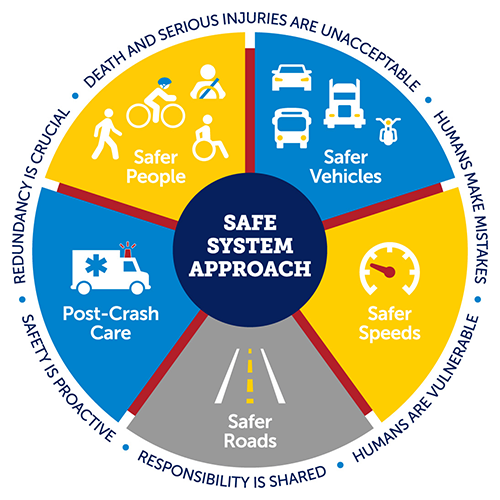
The Safe Systems Approach is a comprehensive framework to significantly reduce and eventually eliminate all traffic fatalities and serious injuries on roadways.
Principles:
1. Death and serious injury on public roadways is unacceptable.
2. Humans make mistakes.
3. Humans are vulnerable.
4. Responsibility is shared.
5. Safety is proactive.
6. Redundancy is crucial.
Vision Zero Action Plan
The project has a steering committee comprised of local agency staff, tribal representatives, ambulance providers, advocates, transit providers, Caltrans, and law enforcement. The Project Task Force (or PTF) will meet every two months throughout the project to provide feedback and guide development.
Project Task Force #1 June 2025:
Project Task Force #2 on Tuesday September 23, 2025:
Presentation slides on public engagement, crash analysis, and demonstration projects and meeting notes
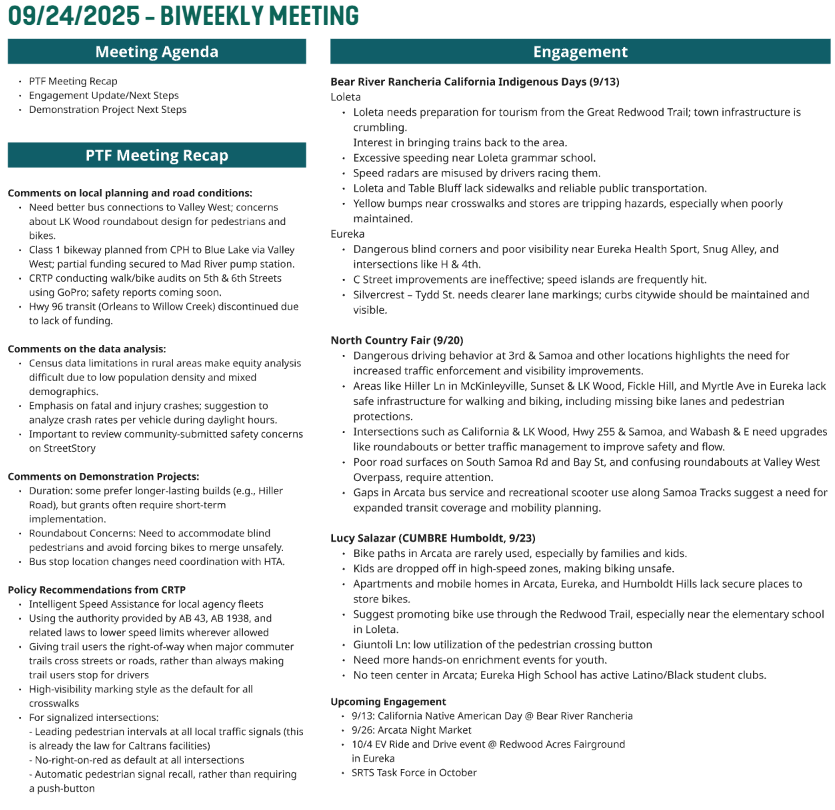
Project Task Force #3 July 21, 2026
Presentation slides on policies and countermeasures, education campaign, and data dashboard
Vision Zero demonstration projects coming Summer 2026
HCAOG is working with local agency staff to install temporary traffic calming measures in Arcata, Eureka, Fortuna, and Ferndale as part of the federally funded Humboldt County Vision Zero Action Plan. Between 2018 and 2024, there were 165 fatal collisions in Humboldt County. These demonstrations are a direct step toward changing that. What do you think about the traffic safety demonstrations? Let us know in the short survey at https://bit.ly/HumVZAP.
Each project uses temporary materials so engineers can study real-world outcomes before recommending permanent improvements. Here's what's going in:
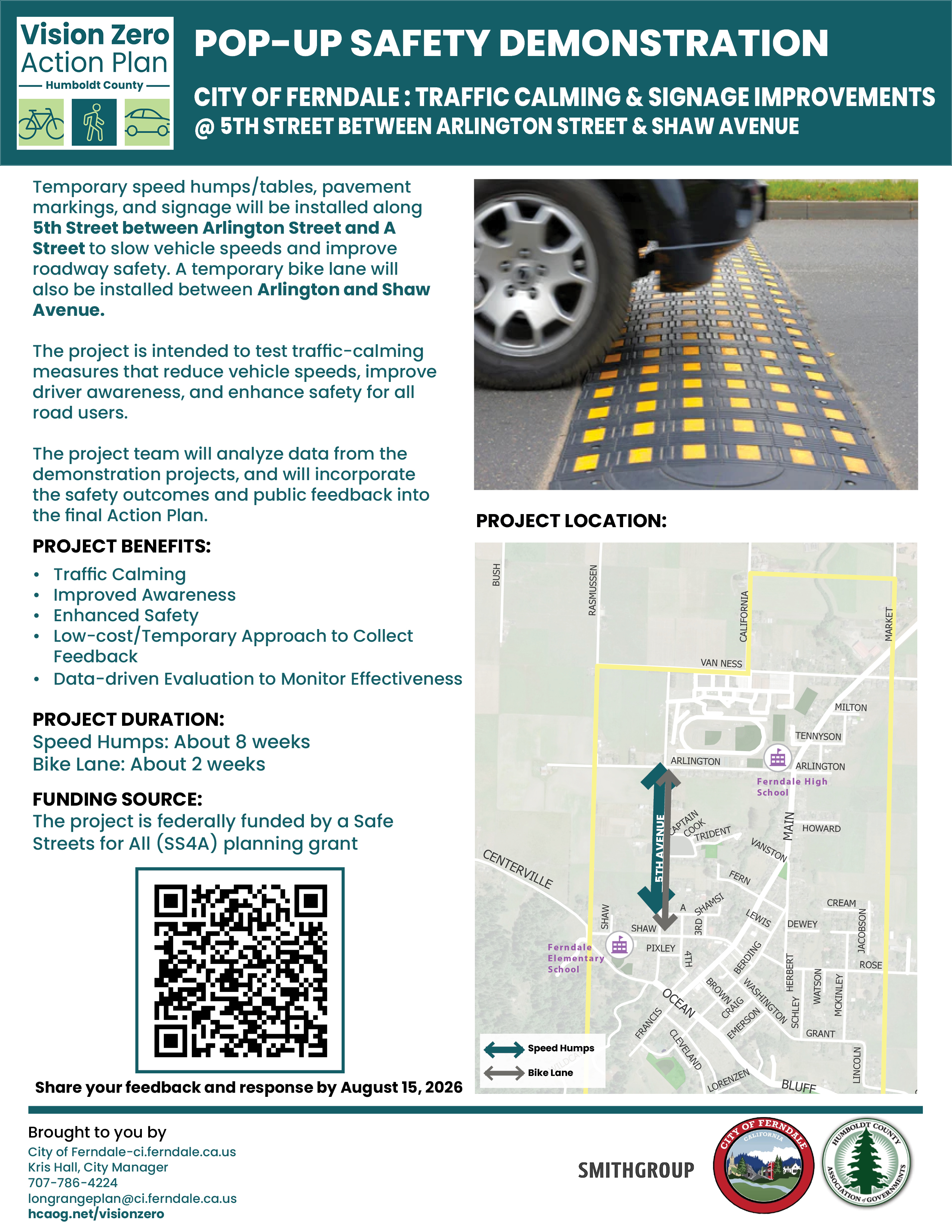
Ferndale — Speed humps, pavement markings and temporary bike lane striping along 5th Avenue between Arlington Street and Shaw Avenue. Project Fact Sheet
Project team will be on-site Monday 7/20 from 4-7 PM along 5th Ave.
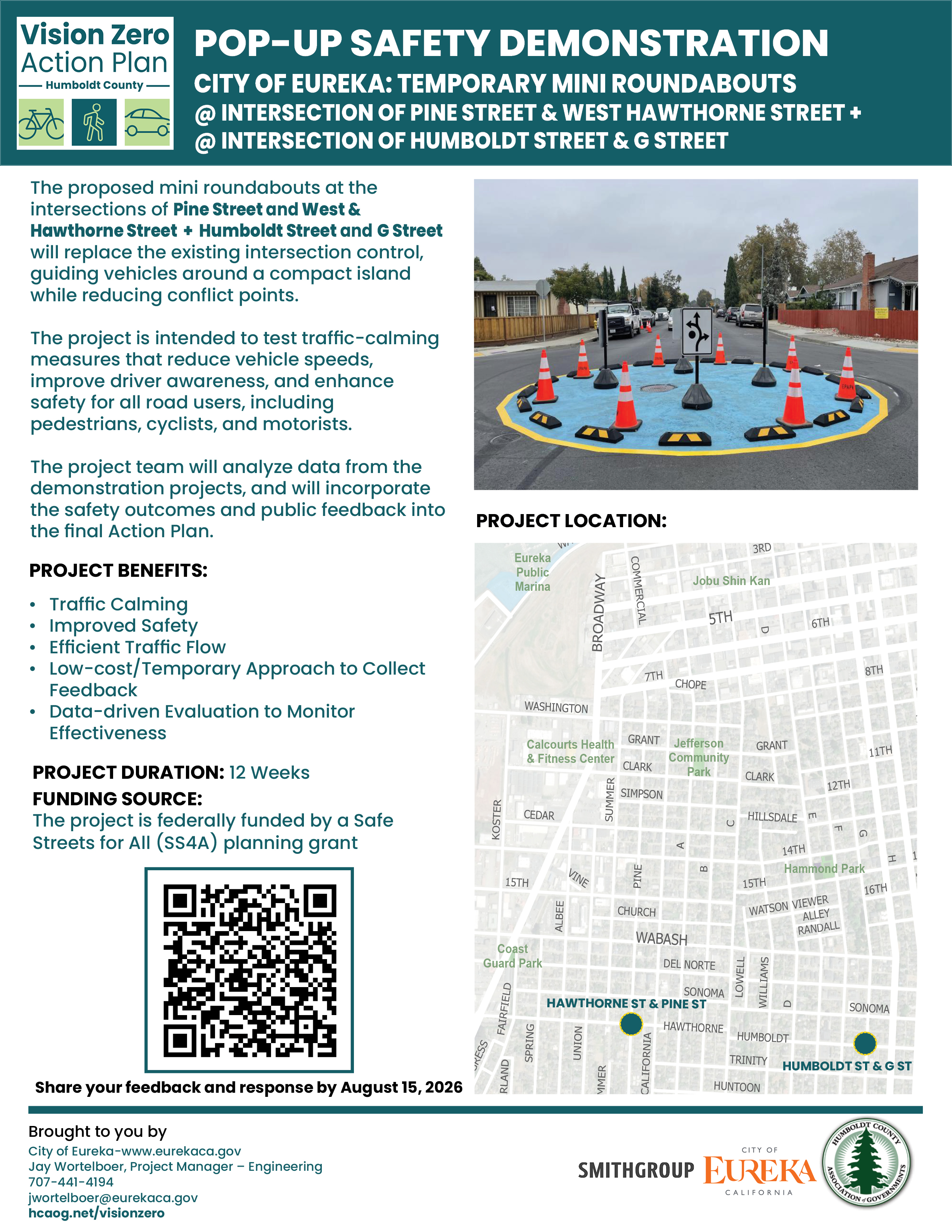
Eureka — Temporary mini roundabout striping, wheel stops, and delineators at Pine Street and West Hawthorne Street, and at Humboldt Street and G Street. Project Fact Sheet
Project team will be on-site Tuesday 7/21 from 12:30-1:45 at Pine St/W. Hawthorne; 1:45-3:30 PM at G/Humboldt
Arcata — Four rubber speed humps at locations on 11th and K Streets to supplement existing radar speed feedback signs. Project Fact Sheet
Project team will be on-site Tuesday 7/21 from 4-7 PM at intersection of 11th and K Streets.
- Fortuna — Programmable radar speed feedback signs on the 12th Street and Ross Hill Road school corridors. Project Fact Sheet
.jpg)
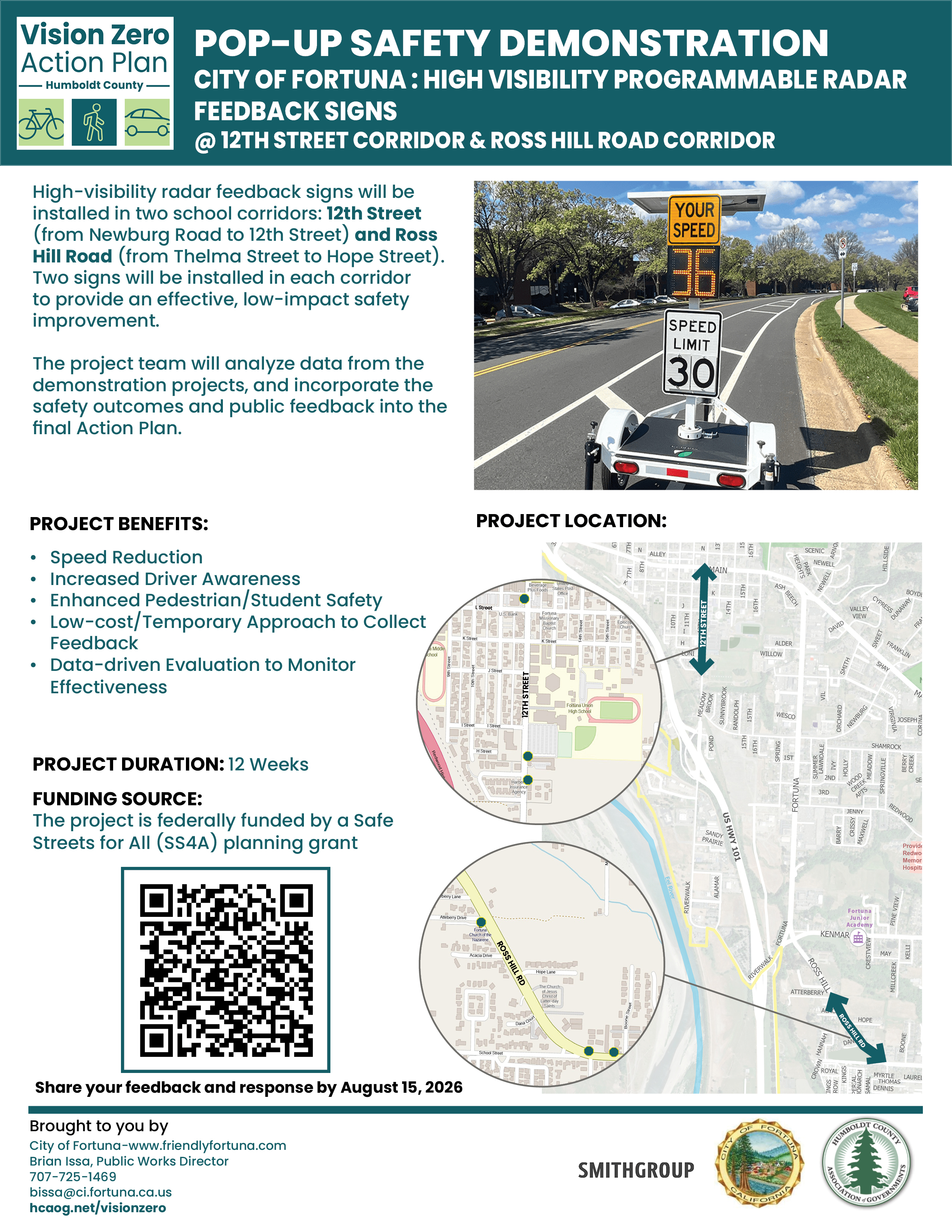
After installation, HCAOG will collect speed and crash data and gather community feedback. Results will directly inform the final Vision Zero Action Plan recommendations expected later in 2026.
GHD led the countywide collision analysis. Using California Highway Patrol California Crash Reporting System and Transportation Injury Mapping System data, the report uses a seven year history from 2018 to 2024 to analyze the trends of roadway fatalities and serious injuries. The report highlights the 'hotspots' in the County and serves as the basis for the High Injury Network analysis and recommended policies and countermeasures.
The draft regional policies that will be discussed at the next Project Steering Group meeting are available here.
In 2024 HCAOG staff began the process of identifying a smart traffic camera system that could be used as part of the Vision Zero project and beyond. The total budget for the camera system included in the project is $30,000, which is funded by HCAOG local funds and is part of the match to the federal grant. Smart cameras offer insights into traffic patterns, such as near misses at intersections, that can proactively improve safety. The AI systems in the cameras detect object types (pedestrians, bikes, cars) and behaviors (speed, direction, near-misses) but do not use facial recognition, license plate reading, or any identifiable tracking of individuals.
The TAC reviewed various systems including Viva, MioVision, and Currux. As the other systems required ongoing subscription costs to use and analyze any data, the Currux unit designed by Western Systems was selected by the TAC as the preferred vendor as the data and analysis could be readily downloaded from the unit without additional data processing costs.
The Western Systems team installed a test unit at the intersection of 6th and I Streets in Eureka that was operational between September and December 2025. Western Systems staff presented the results and functionality of the demo installation to the TAC, showcasing how the system functions to show data for user counts (bike, pedestrian, car, truck, etc.), speeds, and near misses.
As of June 2026, HCAOG has purchased the Currux Vision unit. City of Eureka staff deployed the camera to the intersection of G and Humboldt to collect data prior to installing the demonstration mini-roundabout. The Vision Zero Action Plan will integrate the data and findings from the traffic safety camera, and the unit will be available for local agencies to use across the region.
Resources
The Local Road Safety Plan (LRSP) is a traffic safety planning document for local agencies to address unique roadway safety needs in their jurisdictions. These documents evaluate crash data and integrate public feedback to identify strategies and countermeasures for improving road safety on local roads. LRSPs help local agencies qualify for federal grant funding such as the Highway Safety Improvement Program (HSIP). The Regional Vision Zero Action Plan is similar to an LRSP, but is better positioned to analyze road segments that cross jurisdictional boundaries.
- Proven countermeasures documents interventions that work.
- The Vision Zero Action Network is a non-profit dedicated to helping communities achieve their Vision Zero campaigns. See their extensive list of resources for planners and advocates.
- Zero Deaths and Safe System - US Federal Highway Administration
- The CA Office of Traffic Safety has Safe System resources.